| docs/screenshots | ||
| document-parser | ||
| frontend | ||
| .env.example | ||
| .gitignore | ||
| docker-compose.yml | ||
| LICENSE | ||
| README.md | ||

Docling Studio



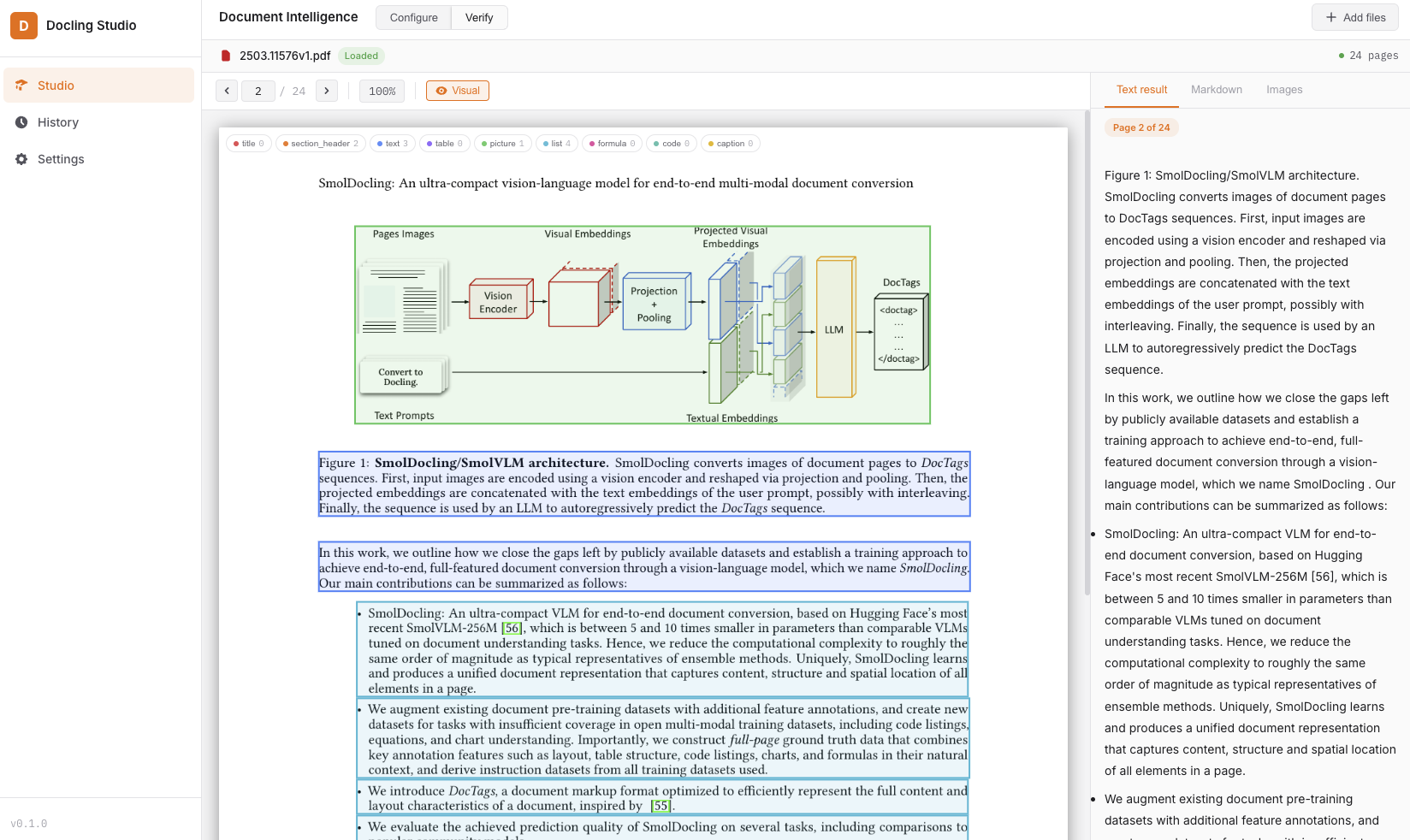
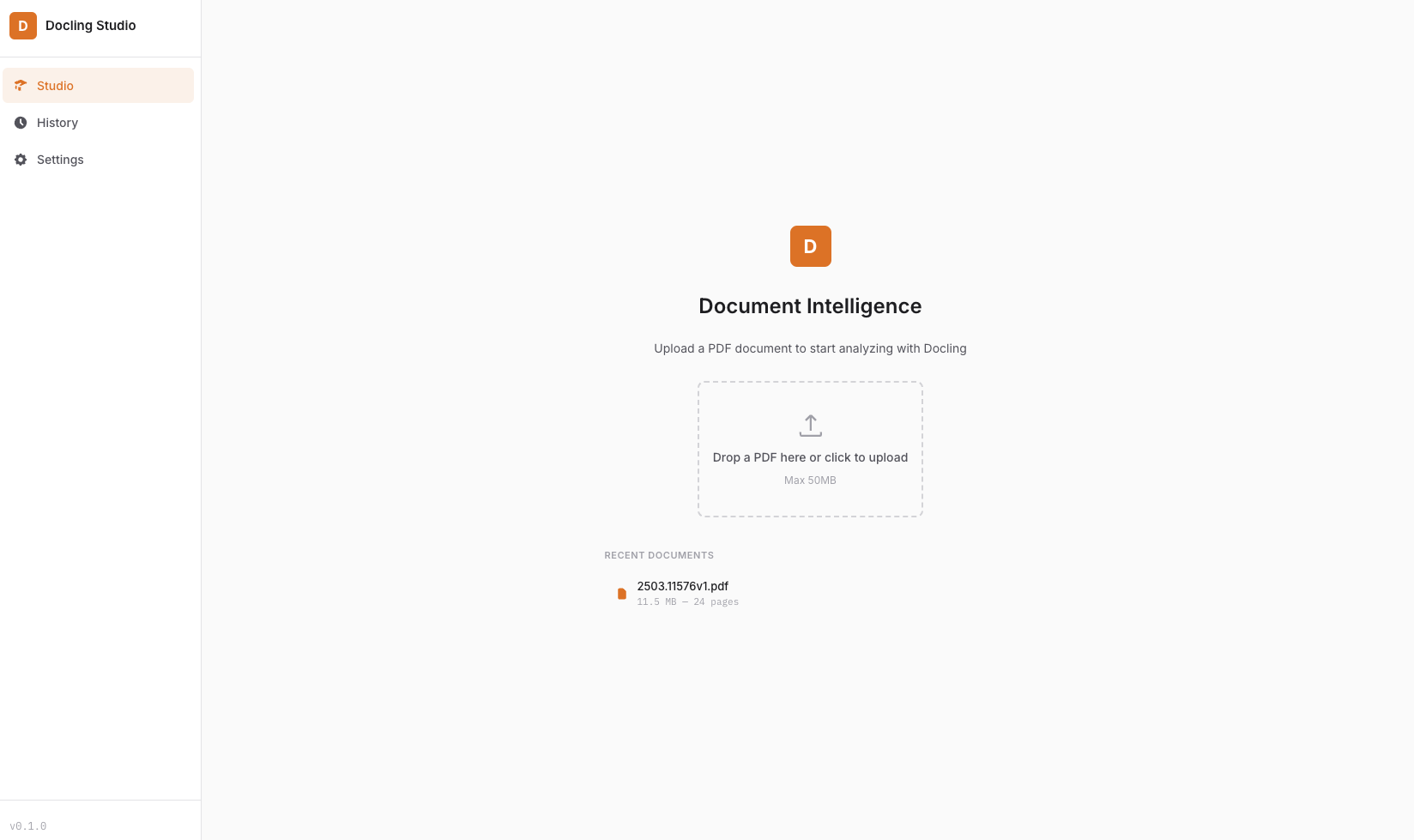
A visual document analysis studio powered by Docling. Upload a PDF, configure the extraction pipeline, and visualize the results — text, tables, images, formulas, bounding boxes — all from your browser.
Features
- PDF viewer with page navigation and visual overlay toggle
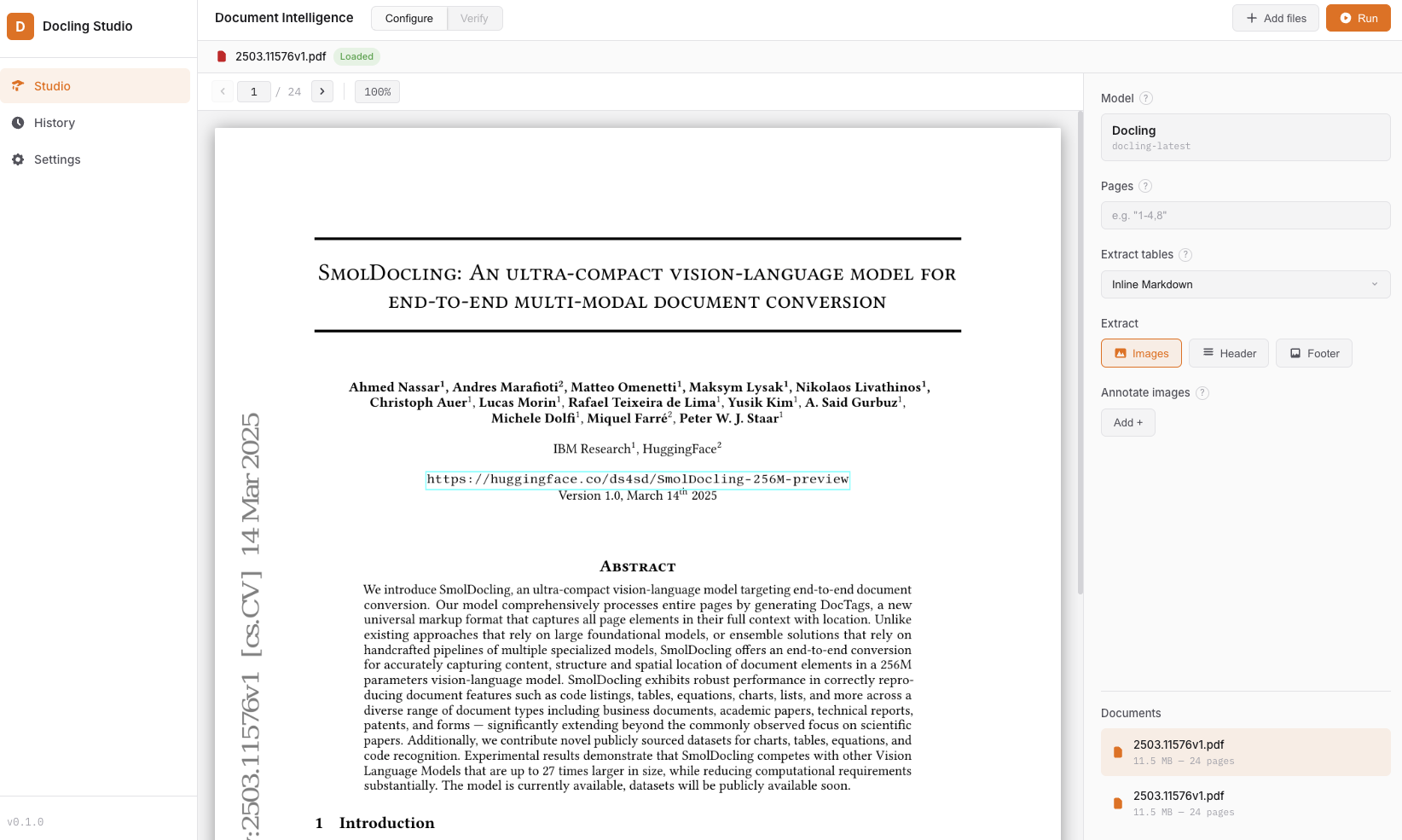
- Configurable Docling pipeline — OCR on/off, table extraction mode (fast/accurate)
- Bounding box visualization — overlay extracted elements directly on the PDF with color-coded types
- Per-page results — right panel syncs with the current PDF page
- Document hierarchy — heading levels and structure preserved from Docling's
iterate_items()API - Markdown & HTML export of extracted content
- Analysis history — re-visit past analyses
More screenshots
| Import | Configure | Results |
|---|---|---|
 |
 |
|
Architecture
┌────────────┐         ┌───────────────────────┐
│  Frontend   │────────▶│   Document Parser      │
│  Vue 3      │  /api/* │ FastAPI + Docling       │
│  port 3000  │         │ SQLite + file storage   │
└────────────┘         │   port 8000             │
                        └───────────────────────┘
| Service | Stack | Role |
|---|---|---|
| frontend | Vue 3, Vite, Pinia | UI, PDF viewer, results display |
| document-parser | FastAPI, Docling, SQLite, pdf2image | REST API, document parsing, storage, persistence |
Python project structure (clean architecture)
document-parser/
├── main.py                   # FastAPI app, CORS, lifespan
├── domain/                   # Pure domain models & Docling logic
│   ├── models.py             # Document, AnalysisJob dataclasses
│   └── parsing.py            # Docling conversion & page extraction
├── api/                      # HTTP layer (FastAPI routers)
│   ├── schemas.py            # Pydantic DTOs (camelCase serialization)
│   ├── documents.py          # /api/documents endpoints
│   └── analyses.py           # /api/analyses endpoints
├── persistence/              # Data layer (SQLite)
│   ├── database.py           # Connection management, schema init
│   ├── document_repo.py      # Document CRUD
│   └── analysis_repo.py      # AnalysisJob CRUD
└── services/                 # Use case orchestration
    ├── document_service.py   # Upload, delete, preview
    └── analysis_service.py   # Async Docling processing
Quick Start
Docker Compose (recommended)
# Clone the repo
git clone https://github.com/scub-france/docling-studio.git
cd docling-studio

# (Optional) customize settings
cp .env.example .env

# Start all services
docker compose up --build
Note: The first analysis takes a bit longer as Docling downloads and caches its ML models (~400 MB). Subsequent runs are fast.
Local Development
Document Parser (Python 3.12+):
cd document-parser
python -m venv .venv && source .venv/bin/activate
pip install -r requirements.txt
uvicorn main:app --reload --port 8000
Frontend (Node 20+):
cd frontend
npm install
npm run dev
Docling Integration
The document parser wraps Docling with configurable pipeline options exposed as query parameters on the /parse endpoint:
| Parameter | Default | Description |
|---|---|---|
do_ocr |
true |
Enable OCR for scanned documents |
do_table_structure |
true |
Enable table structure extraction |
table_mode |
accurate |
Table extraction mode: accurate or fast |
Element types are detected using isinstance() checks against Docling's type hierarchy (TextItem, TableItem, PictureItem, SectionHeaderItem, etc.) and the document tree depth from iterate_items() is preserved for heading-level reconstruction.
Configuration
All configuration is done via environment variables. See .env.example for available options.
| Variable | Default | Description |
|---|---|---|
CORS_ORIGINS |
http://localhost:3000,... |
CORS allowed origins (comma-separated) |
UPLOAD_DIR |
./uploads |
File storage directory |
DB_PATH |
./data/docling_studio.db |
SQLite database path |
Performance & System Requirements
Docling leverages optimized ML models (layout analysis, OCR, table structure) that run efficiently on CPU. The first analysis takes slightly longer as models are downloaded and cached (~400 MB). Subsequent runs are fast, even on large documents.
| Document type | Pages | Approx. time (CPU) |
|---|---|---|
| Simple report | 5-10 | ~30s-1 min |
| Research paper | 10-30 | ~1-2 min |
| Large document | 100+ | ~2-5 min |
Docker Desktop settings
The document parser needs at least 4 GB of RAM. Recommended Docker Desktop allocation:
| Resource | Minimum | Recommended |
|---|---|---|
| Memory | 6 GB | 8 GB+ |
| CPUs | 4 | 8+ |
On macOS: Docker Desktop > Settings > Resources On Windows: Docker Desktop > Settings > Resources > WSL 2
Platform support
All Docker images are multi-arch (linux/amd64 + linux/arm64). All processing runs on CPU — no GPU required.
| Platform | Architecture |
|---|---|
| macOS Apple Silicon (M1/M2/M3/M4) | arm64 |
| macOS Intel | amd64 |
| Linux x86_64 | amd64 |
| Linux ARM (Raspberry Pi 5, Ampere) | arm64 |
| Windows + WSL2 | amd64 |
Tech Stack
- Frontend: Vue 3 + Vite + Pinia
- Backend: FastAPI + Docling 2.x + SQLite + pdf2image
- Infra: Docker Compose + Nginx
Contributing
Contributions are welcome! Please open an issue first to discuss what you'd like to change.
License
MIT — Pier-Jean Malandrino