 5f000b7974
This commit implements the Unified Resource Architecture for AI-first
infrastructure management. Key features:

Phase 1 - Backend Unification:
- New unified Resource type with 9 resource types, 7 platforms, 7 statuses
- Resource store with identity-based deduplication (hostname, machineID, IP)
- 8 converter functions (FromNode, FromVM, FromContainer, etc.)
- REST API endpoints: /api/resources, /api/resources/stats, /api/resources/{id}
- 28 comprehensive unit tests

Phase 2 - AI Context Enhancement:
- Unified context builder for AI system prompts
- Cross-platform query methods: GetTopByCPU, GetTopByMemory, GetTopByDisk
- Resource correlation: GetRelated (parent, children, siblings, cluster)
- Infrastructure summary: GetResourceSummary with health status counts
- AI context now includes top consumers and infrastructure overview

Phase 3 - Agent Preference & Hybrid Mode:
- Polling optimization methods in resource store
- ResourceStoreInterface added to Monitor
- SetResourceStore() and shouldSkipNodeMetrics() helper methods
- Store automatically wired into Monitor via Router.SetMonitor()
- Foundation ready for reduced API polling when agents are active

Files added:
- internal/resources/resource.go - Core Resource type
- internal/resources/store.go - Store with deduplication
- internal/resources/converters.go - Type converters
- internal/resources/platform_data.go - Platform-specific data
- internal/resources/store_test.go - 28 tests
- internal/resources/converters_test.go - Converter tests
- internal/api/resource_handlers.go - REST API handlers
- internal/ai/resource_context.go - AI context builder
- .gemini/docs/unified-resource-architecture.md - Architecture docs

All tests pass.
|
||
|---|---|---|
| .gemini | ||
| .github | ||
| cmd | ||
| deploy/helm/pulse | ||
| dev/oidc | ||
| docs | ||
| frontend-modern | ||
| internal | ||
| pkg | ||
| scripts | ||
| security | ||
| testing-tools | ||
| tests/integration | ||
| .dockerignore | ||
| .env.example | ||
| .gitattributes | ||
| .gitguardian.yaml | ||
| .gitignore | ||
| .golangci.yml | ||
| ARCHITECTURE.md | ||
| artifacthub-repo.yml | ||
| CONTRIBUTING.md | ||
| cr.yaml | ||
| DEV-QUICK-START.md | ||
| docker-compose.yml | ||
| docker-entrypoint.sh | ||
| Dockerfile | ||
| go.mod | ||
| go.sum | ||
| install.sh | ||
| LICENSE | ||
| Makefile | ||
| mock.env | ||
| README.md | ||
| SECURITY.md | ||
| VERSION | ||

Pulse
Real-time monitoring for Proxmox VE, Proxmox Mail Gateway, PBS, and Docker infrastructure.



🚀 Overview
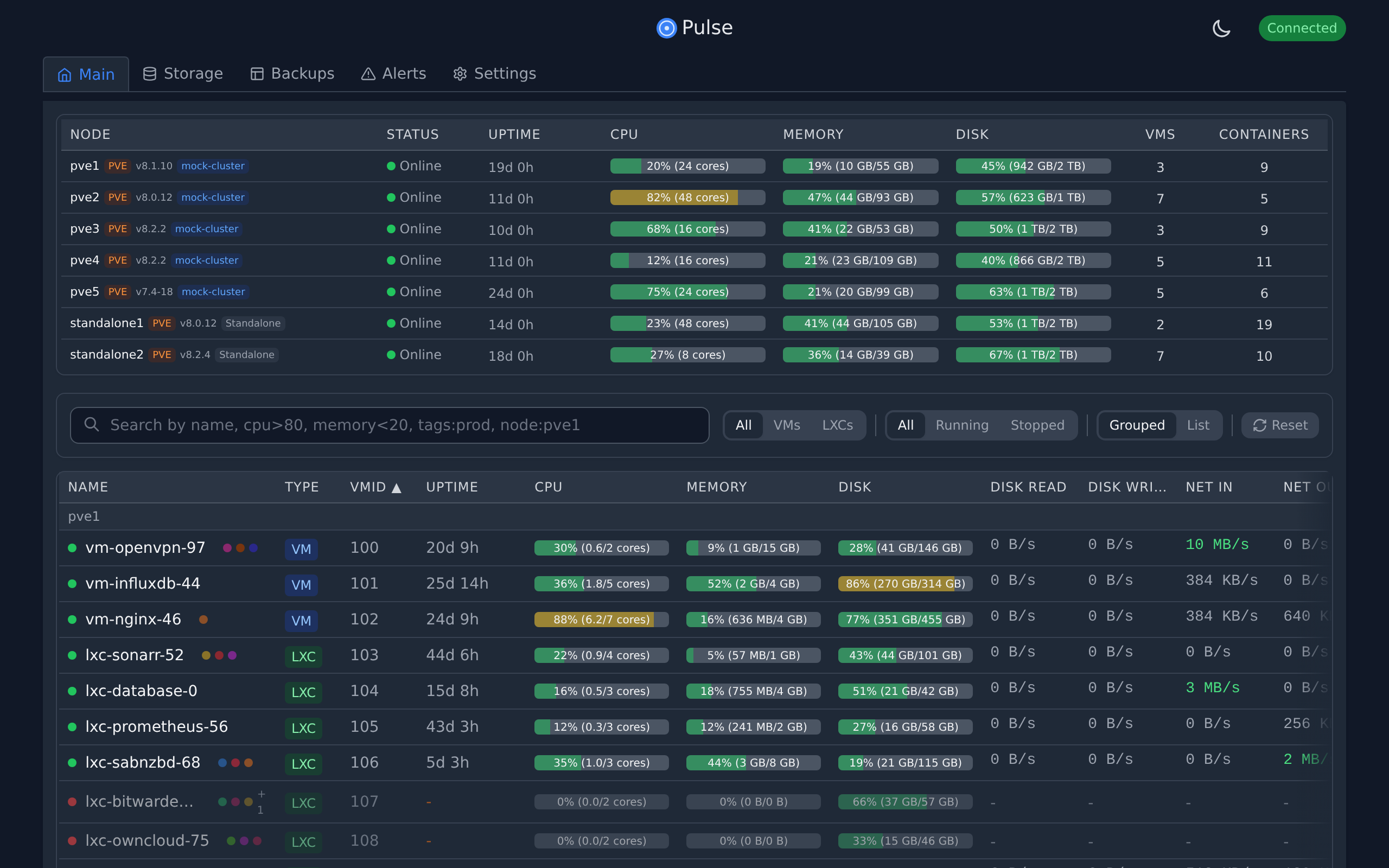
Pulse is a modern, unified dashboard for your Proxmox and Docker estate. It consolidates metrics, logs, and alerts from Proxmox VE, Proxmox Backup Server, Proxmox Mail Gateway, and standalone Docker hosts into a single, beautiful interface.
Designed for homelabs, sysadmins, and MSPs who need a "single pane of glass" without the complexity of enterprise monitoring stacks.
✨ Features
- Unified Monitoring: View health and metrics for PVE, PBS, PMG, and Docker containers in one place.
- Smart Alerts: Get notified via Discord, Slack, Telegram, Email, and more when things go wrong (e.g., "VM down", "Storage full").
- Auto-Discovery: Automatically finds Proxmox nodes on your network.
- Secure by Design: Credentials encrypted at rest, no external dependencies, and strict API scoping.
- Backup Explorer: Visualize backup jobs and storage usage across your entire infrastructure.
- Privacy Focused: No telemetry, no phone-home, all data stays on your server.
- Lightweight: Built with Go and React, running as a single binary or container.
⚡ Quick Start
Option 1: Proxmox LXC (Recommended)
Run this one-liner on your Proxmox host to create a lightweight LXC container:
curl -fsSL https://github.com/rcourtman/Pulse/releases/latest/download/install.sh | bash
Option 2: Docker
docker run -d \
  --name pulse \
  -p 7655:7655 \
  -v pulse_data:/data \
  --restart unless-stopped \
  rcourtman/pulse:latest
Access the dashboard at http://<your-ip>:7655.
📚 Documentation
- Installation Guide: Detailed instructions for Docker, Kubernetes, and bare metal.
- Configuration: Setup authentication, notifications, and advanced settings.
- Security: Learn about Pulse's security model and best practices.
- API Reference: Integrate Pulse with your own tools.
- Architecture: High-level system design and data flow.
- Troubleshooting: Solutions to common issues.
🌐 Community Integrations
Community-maintained integrations and addons:
- Home Assistant Addons - Run Pulse Agent and Pulse Server as Home Assistant addons.
❤️ Support Pulse Development
Pulse is maintained by one person. Sponsorships help cover the costs of the demo server, development tools, and domains. If Pulse saves you time, please consider supporting the project!


📄 License
MIT © Richard Courtman