 4d7d2e42dc
Instead of relying on pre-computed trend heuristics (which can be misleading for edge cases like step changes vs continuous growth), we now pass downsampled raw data points to the LLM so it can interpret patterns directly. Changes: - Add MetricSamples field to ResourceContext - Add DownsampleMetrics() to reduce data points for LLM consumption - Add formatMetricSamples() to format data compactly (e.g., 'Disk: 26→26→31%') - Add computeGuestMetricSamples() to gather 7-day sampled history - Populate MetricSamples for VMs and containers during context build - Add History section to formatted context output The LLM now sees actual patterns like 'stable for 6 days then jumped' rather than just '45.8%/day growth rate' - allowing for much more nuanced interpretation. This approach: - Leverages LLM's pattern recognition instead of hard-coded heuristics - Provides 7 days of data (~24 samples) for context on normal behavior - Uses minimal tokens due to compact formatting with deduplication - Is more future-proof as LLMs improve Example output: **History (7d sampled, oldest→newest)**: Disk: 26→26→26→26→26→31% Refs: Frigate disk usage false positive investigation |
||
|---|---|---|
| .github | ||
| cmd | ||
| deploy/helm/pulse | ||
| dev/oidc | ||
| docs | ||
| frontend-modern | ||
| internal | ||
| pkg | ||
| scripts | ||
| security | ||
| testing-tools | ||
| tests/integration | ||
| .dockerignore | ||
| .env.example | ||
| .gitattributes | ||
| .gitguardian.yaml | ||
| .gitignore | ||
| .golangci.yml | ||
| ARCHITECTURE.md | ||
| artifacthub-repo.yml | ||
| CONTRIBUTING.md | ||
| cr.yaml | ||
| docker-compose.yml | ||
| docker-entrypoint.sh | ||
| Dockerfile | ||
| go.mod | ||
| go.sum | ||
| install.sh | ||
| LICENSE | ||
| Makefile | ||
| mock.env | ||
| README.md | ||
| SECURITY.md | ||
| VERSION | ||

Pulse
Real-time monitoring for Proxmox VE, Proxmox Mail Gateway, PBS, and Docker infrastructure.



🚀 Overview
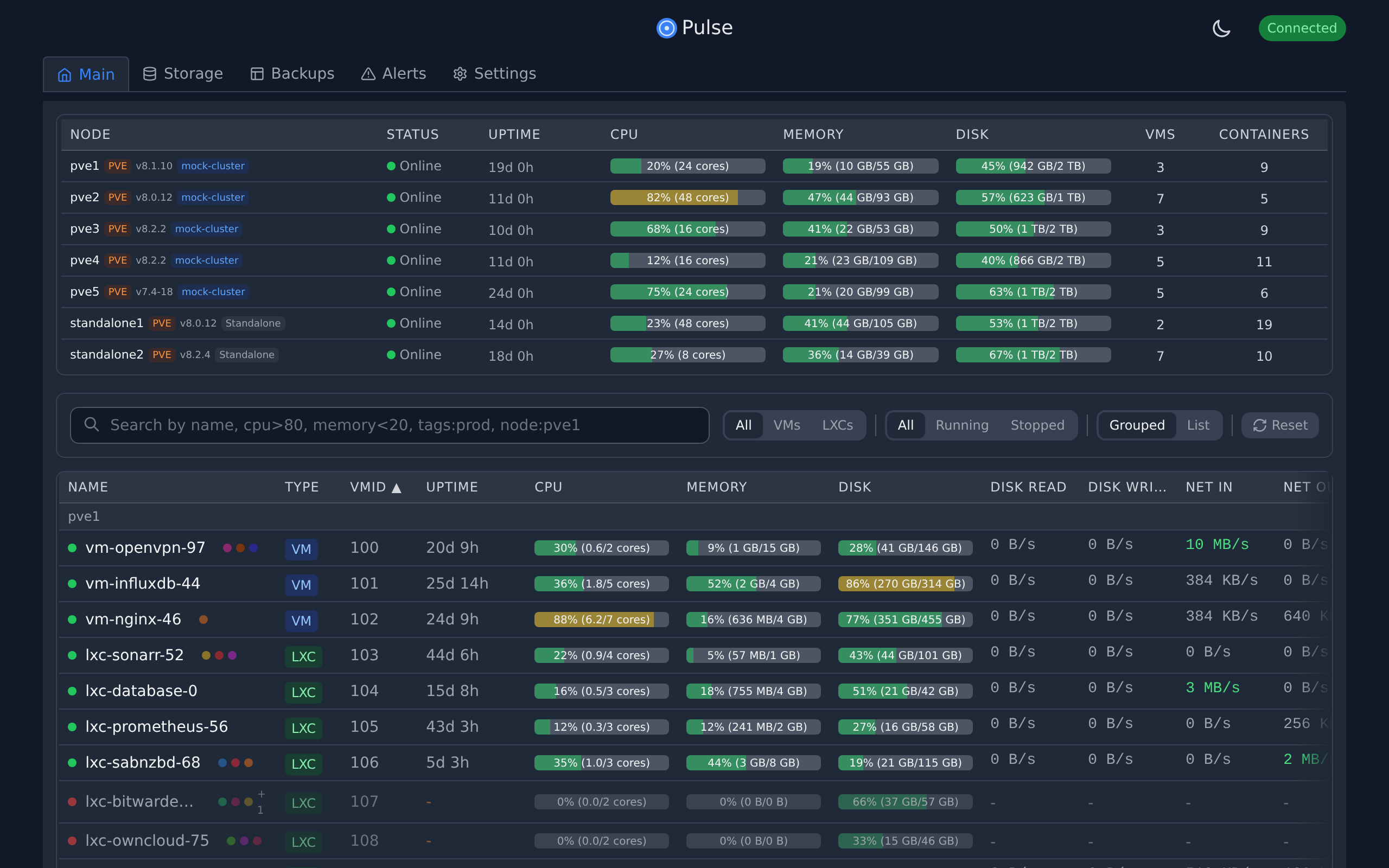
Pulse is a modern, unified dashboard for monitoring your infrastructure across Proxmox, Docker, and Kubernetes. It consolidates metrics, alerts, and AI-powered insights from all your systems into a single, beautiful interface.
Designed for homelabs, sysadmins, and MSPs who need a "single pane of glass" without the complexity of enterprise monitoring stacks.
✨ Features
Core Monitoring
- Unified Monitoring: View health and metrics for PVE, PBS, PMG, Docker, and Kubernetes in one place
- Smart Alerts: Get notified via Discord, Slack, Telegram, Email, and more
- Auto-Discovery: Automatically finds Proxmox nodes on your network
- Metrics History: Persistent storage with configurable retention
- Backup Explorer: Visualize backup jobs and storage usage
Pulse AI (New in 5.0)
- Chat Assistant: Ask questions about your infrastructure in natural language
- Patrol: Background health checks that generate findings on a schedule
- Alert Analysis: Optional AI analysis when alerts fire
- Cost Tracking: Track usage and costs per provider/model
Multi-Platform
- Proxmox VE/PBS/PMG: Full monitoring and management
- Kubernetes: Complete K8s cluster monitoring via agents
- Docker/Podman: Container and Swarm service monitoring
- OCI Containers: Proxmox 9.1+ native container support
Security & Operations
- Secure by Design: Credentials encrypted at rest, strict API scoping
- One-Click Updates: Easy upgrades for supported deployments
- OIDC/SSO: Enterprise authentication support
- Privacy Focused: No telemetry, all data stays on your server
⚡ Quick Start
Option 1: Proxmox LXC (Recommended)
Run this one-liner on your Proxmox host to create a lightweight LXC container:
curl -fsSL https://github.com/rcourtman/Pulse/releases/latest/download/install.sh | bash
Option 2: Docker
docker run -d \
  --name pulse \
  -p 7655:7655 \
  -v pulse_data:/data \
  --restart unless-stopped \
  rcourtman/pulse:latest
Access the dashboard at http://<your-ip>:7655.
📚 Documentation
- Installation Guide: Detailed instructions for Docker, Kubernetes, and bare metal.
- Configuration: Setup authentication, notifications, and advanced settings.
- Security: Learn about Pulse's security model and best practices.
- API Reference: Integrate Pulse with your own tools.
- Architecture: High-level system design and data flow.
- Troubleshooting: Solutions to common issues.
🌐 Community Integrations
Community-maintained integrations and addons:
- Home Assistant Addons - Run Pulse Agent and Pulse Server as Home Assistant addons.
❤️ Support Pulse Development
Pulse is maintained by one person. Sponsorships help cover the costs of the demo server, development tools, and domains. If Pulse saves you time, please consider supporting the project!


📄 License
MIT © Richard Courtman